AWS Predictive Site Outage Lakehouse
 AWS Glue
 Kinesis
 Apache Iceberg
 Redshift
 QuickSight
 SNS
 Lambda
 Isolation Forest
What the problem was
Telecom operators usually discover outages after a tower has already degraded enough to fall offline. That means reactive maintenance, emergency dispatches, revenue loss, and a poor customer experience in the affected area.
I wanted to model a more mature operating pattern: ingest physical telemetry from telecom hardware in near real time, detect anomalous multivariate behavior before failure, and surface a practical risk view for both engineering and leadership.
How I solved it
I designed a serverless AWS medallion lakehouse that ingests site telemetry from edge gateways into Kinesis, lands raw events in S3, processes and scores them in AWS Glue, stores curated layers in Apache Iceberg, and exposes executive-ready reporting through Redshift Serverless and QuickSight.
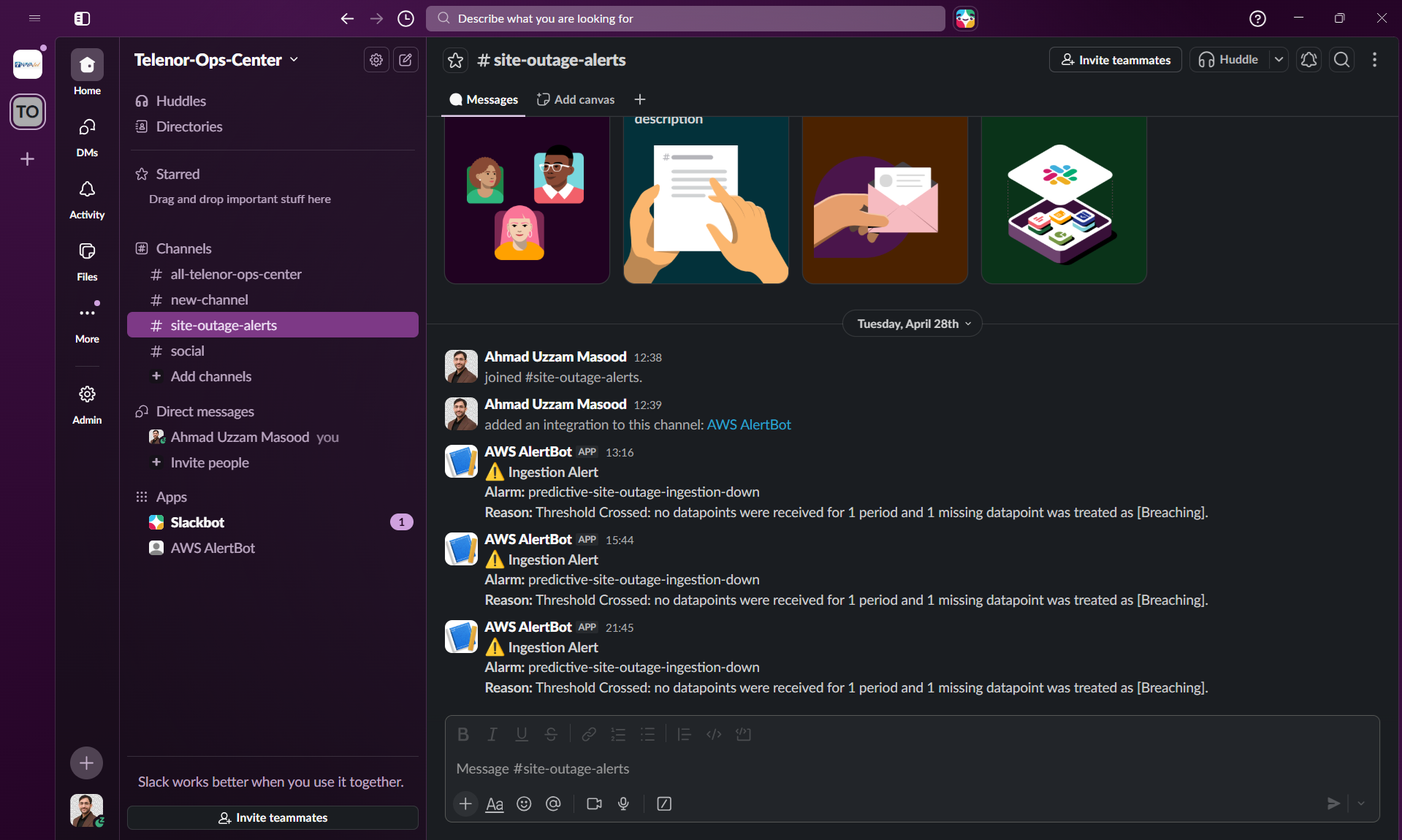
The anomaly-detection path uses an Isolation Forest model applied inside distributed PySpark jobs, while the incident path uses CloudWatch, SNS, and Lambda to push proactive Slack alerts when site behavior becomes risky.
Architecture
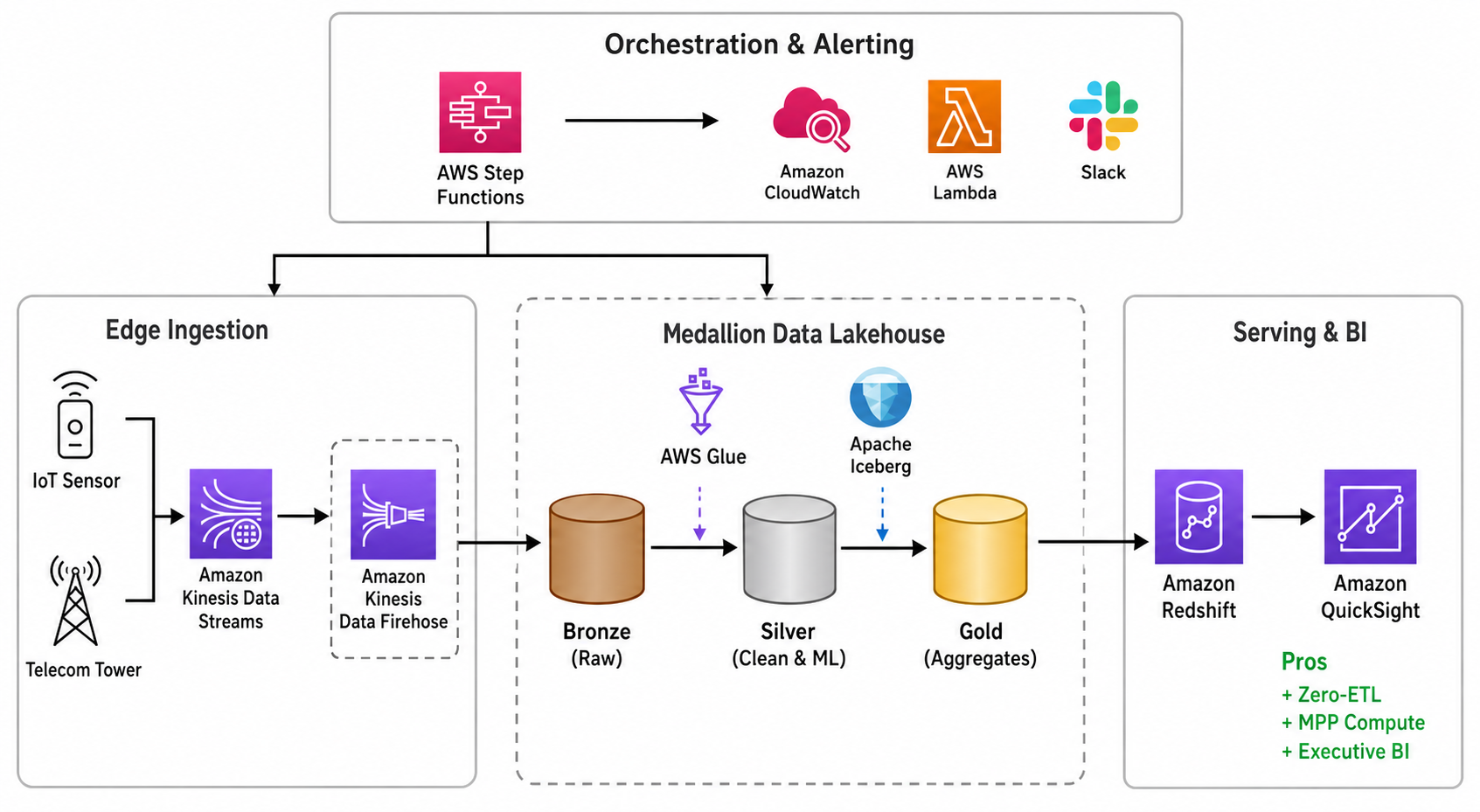
- Edge hardware - rectifiers, PLCs, and HVAC systems at telecom sites produce voltage, current, and temperature telemetry.
- Industrial gateway - polls Modbus TCP / RTU registers, buffers locally during link loss, and publishes encrypted JSON payloads upstream.
- Amazon Kinesis Data Streams - absorbs bursty telemetry and reconnect spikes from offline sites.
- Amazon Kinesis Data Firehose - micro-batches raw JSON to S3 to avoid the small-file problem.
- AWS Glue (PySpark) - enforces schema, applies data-quality handling, and runs anomaly scoring.
- Apache Iceberg on S3 - provides ACID-style
MERGEbehavior for deduplication and change-safe writes. - AWS Step Functions + EventBridge - orchestrates the batch sequence every 15 minutes.
- Amazon CloudWatch + SNS + Lambda - turns elevated anomaly counts into operational Slack alerts.
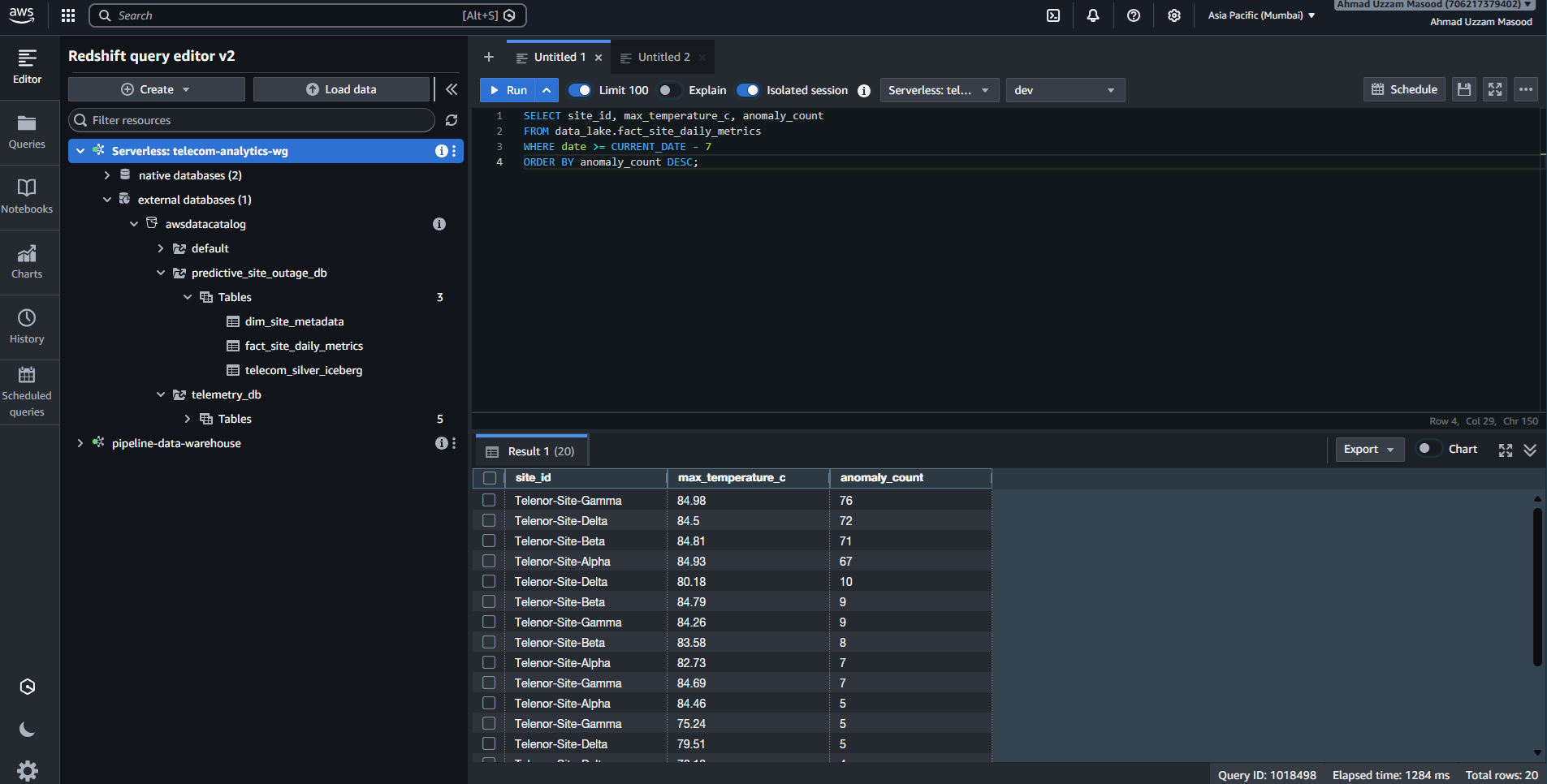
- Amazon Redshift Serverless + QuickSight - powers a zero-ETL executive risk dashboard on top of Gold tables.
Workflow
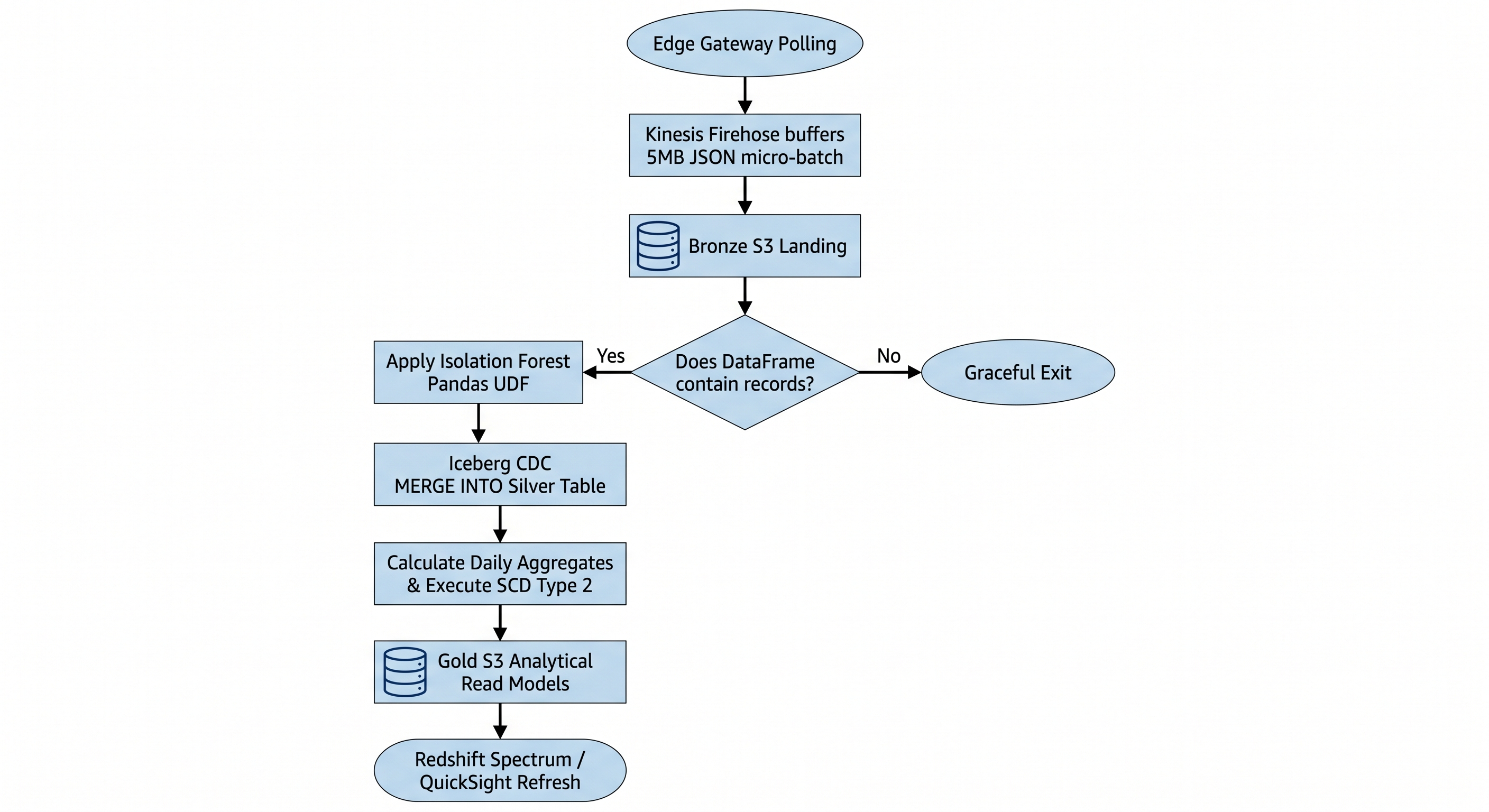
- Edge ingestion - site gateways poll hardware every few seconds, buffer locally when the backhaul drops, and publish flat JSON events into Kinesis.
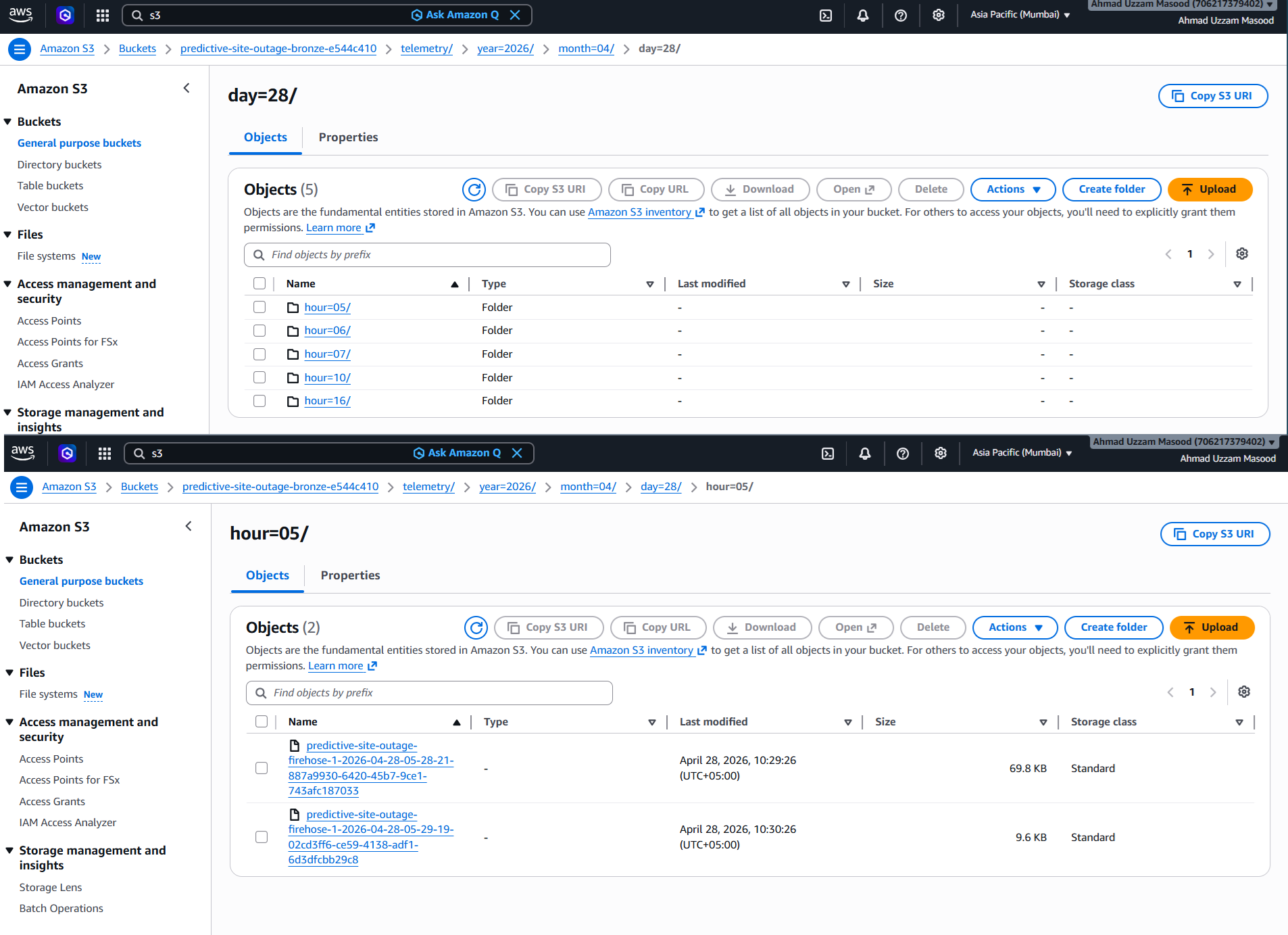
- Bronze landing - Firehose buffers records into 60-second / 5 MB micro-batches and writes partitioned raw JSON into S3.
- Silver enrichment - Glue reads the latest Bronze partitions, enforces schema types, handles bad records, and scores each record with an Isolation Forest model.
- CDC-safe storage - Glue writes results into Silver Iceberg tables using
MERGE INTOso duplicate or late telemetry does not corrupt the dataset. - Gold aggregation - a downstream Glue job builds fact and dimension tables for reporting, including daily site metrics and risk views.
- Alerting - CloudWatch thresholds on anomaly counts trigger SNS, which invokes Lambda to deliver rich Slack alerts with context.
- Serving - Redshift Spectrum mounts the Gold Iceberg tables directly from S3, and QuickSight visualizes site risk, power draw, and thermal trends.
Why these design choices
| Decision | Why it mattered |
|---|---|
| Firehose + Glue micro-batching | Lower cost than running a 24/7 streaming cluster while still meeting a sub-20-minute alerting goal. |
| Apache Iceberg | Enables deduplication and CDC-style MERGE writes directly on the lake without rewriting entire S3 partitions. |
| Isolation Forest in a Pandas UDF | Lets Python ML models run in parallel across Spark workers while preserving distributed execution. |
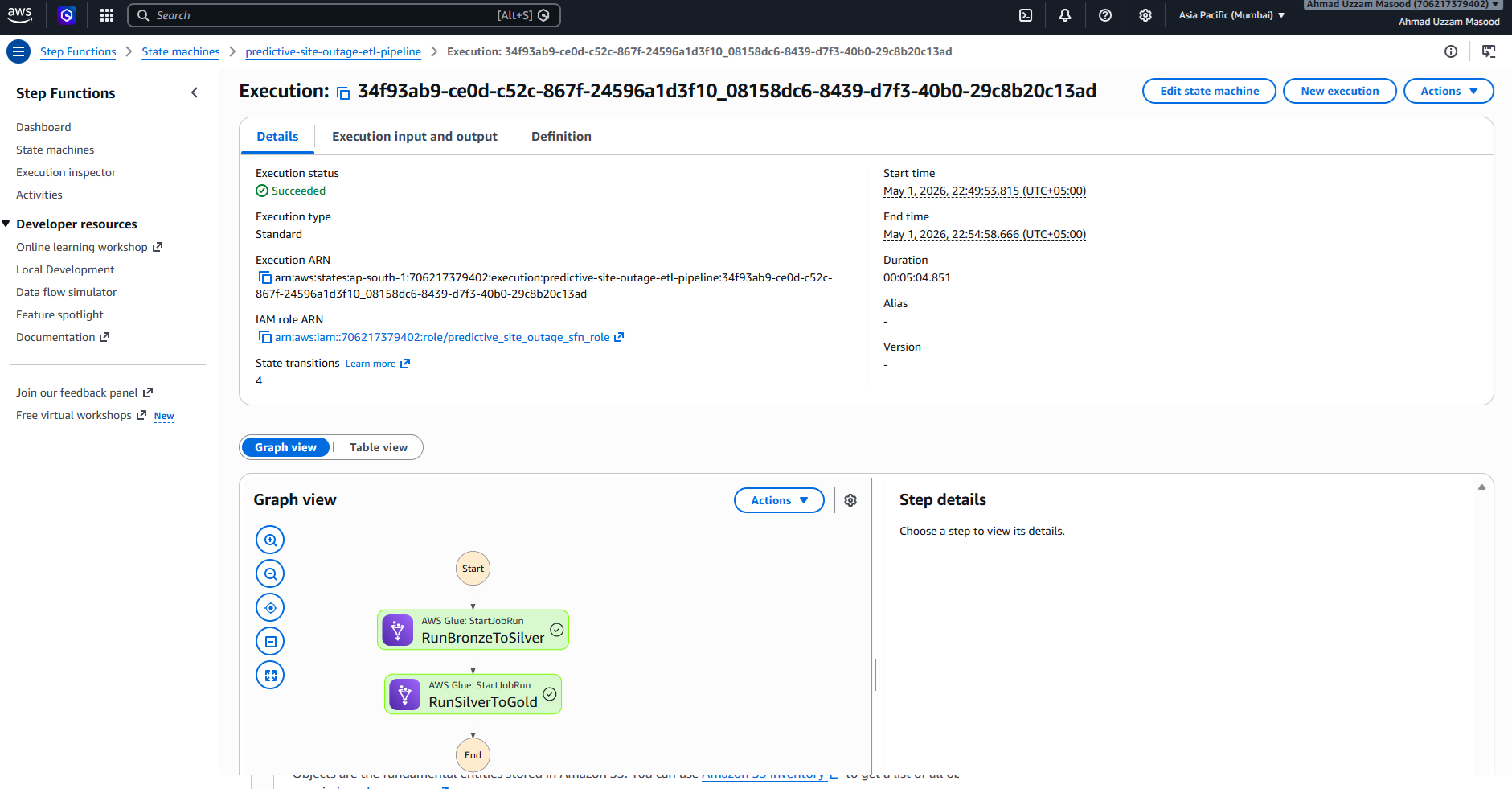
| Step Functions orchestration | Guarantees ordered Bronze -> Silver -> Gold execution instead of depending on loose cron timing. |
| Redshift Spectrum over copied warehouse loads | Preserves a zero-ETL serving pattern and avoids extra data movement into a separate BI store. |
| SNS + Lambda alert fanout | Keeps the ETL layer decoupled from the final incident delivery channel. |
Production-minded details
This project also accounts for real-world edge and lakehouse concerns:
- Offline buffering at the gateway prevents data loss during network drops.
- Burst tolerance in Kinesis helps absorb reconnect storms when many buffered sites come back online.
- Late and duplicate event handling is managed with Iceberg upserts instead of brittle append-only logic.
- Dead-letter handling is part of the design so malformed records do not crash the pipeline.
- Historical correctness can be preserved through dimension modeling patterns such as site-capacity history.
Repository structure
.
├── docs/                 # Architecture and service diagrams
├── glue_jobs/            # PySpark ETL jobs
├── lambda_functions/     # Slack alerting handlers
├── producer/             # Telemetry simulators
├── terraform/            # Infrastructure as Code
├── .github/workflows/    # CI/CD pipelines
├── Makefile              # Automation commands
└── README.md
Deployment flow
git clone https://github.com/azzammasood/aws-predictive-site-outage.git
cd aws-predictive-site-outage
make deploy
You need an AWS account, Terraform 1.4+, Python 3.9+, and a Slack webhook for alert delivery.
Screenshots
If this project helped you, consider giving it a star on GitHub.